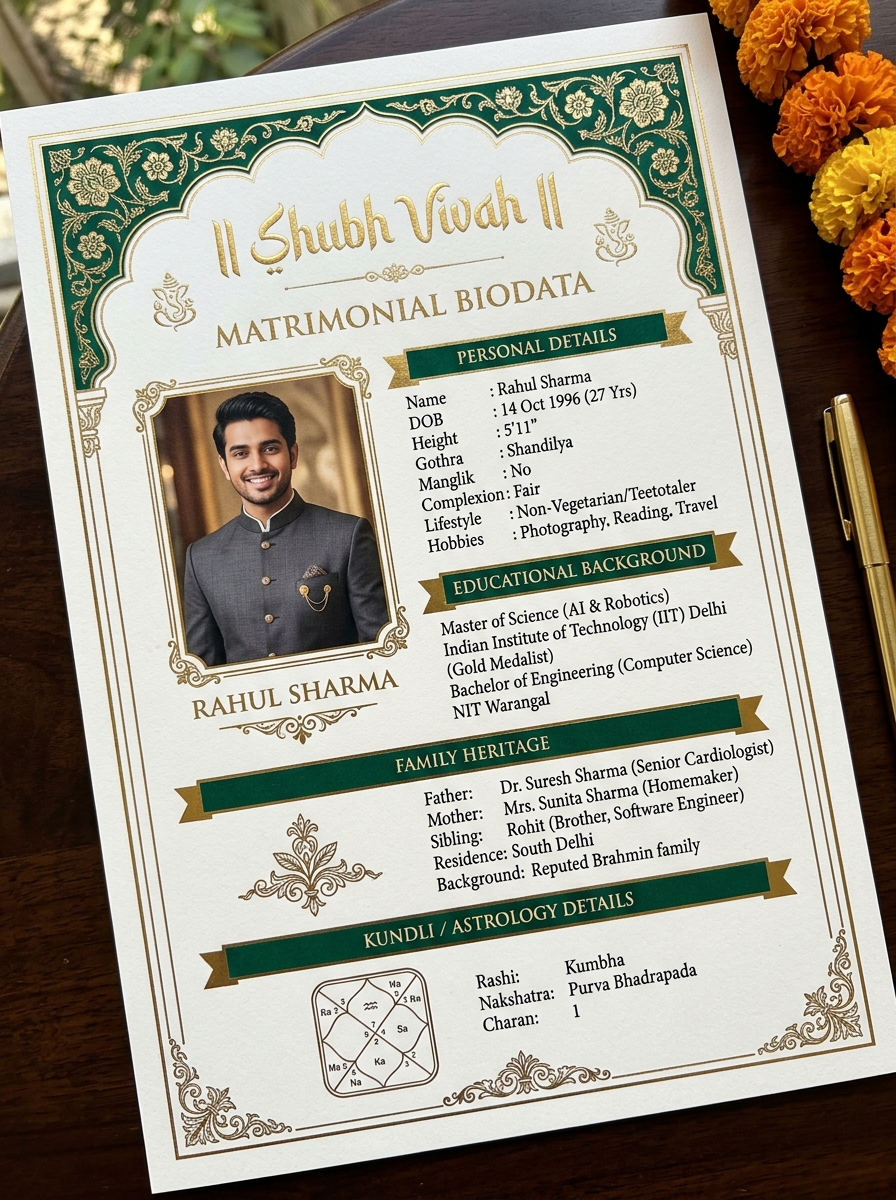
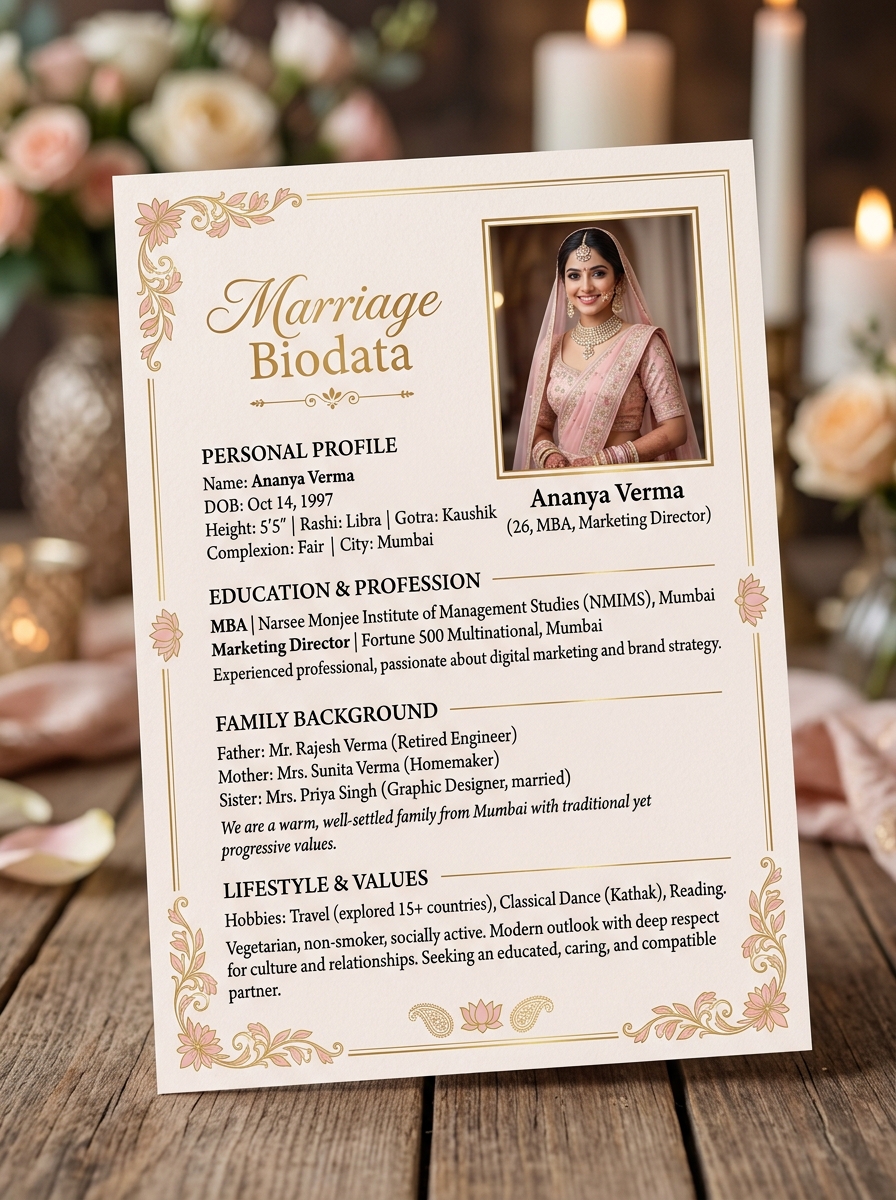
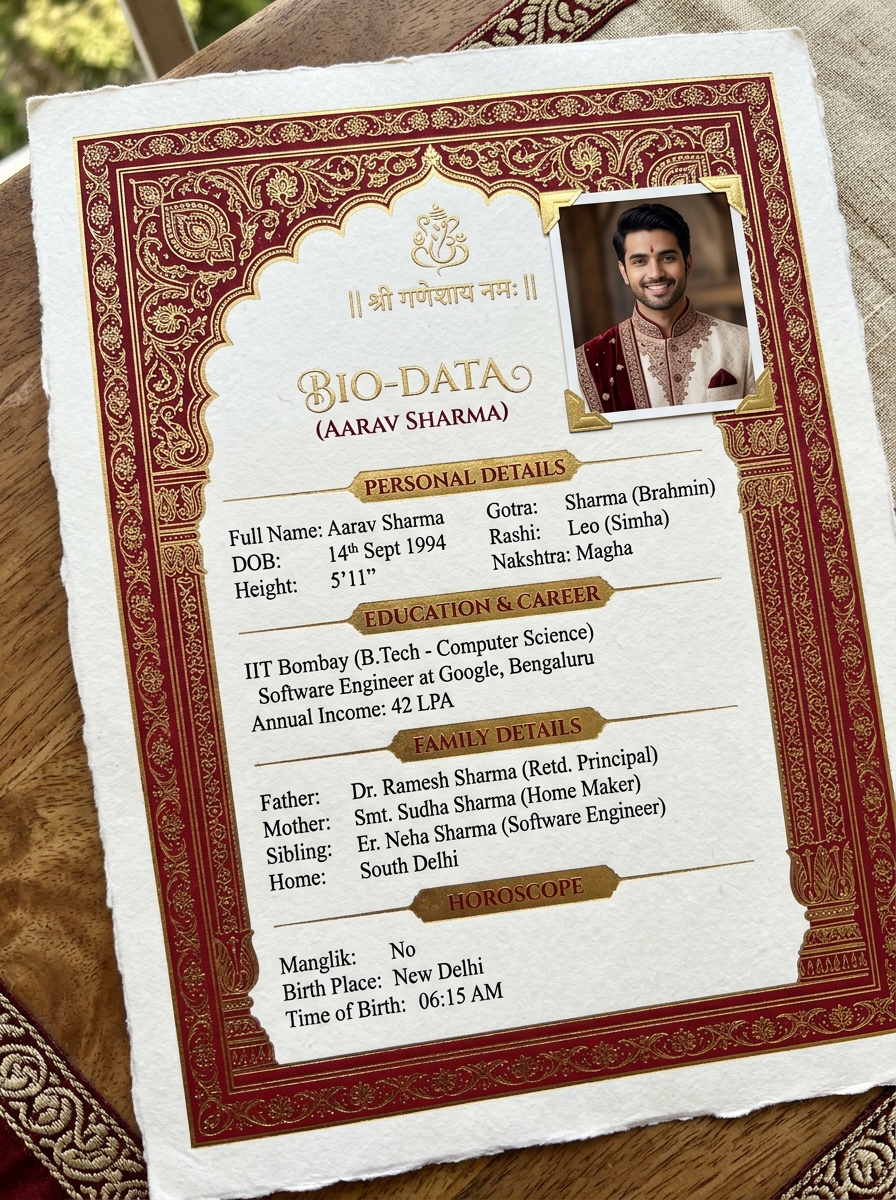
Creating a biodata for marriage may seem easy until you actually start writing one. What details should you include? Should you mention your salary? Do you need to add a photograph? And how do you introduce yourself without making it sound like a job application?
These are common questions for anyone starting their marriage journey.
A marriage biodata is often the first introduction between two people and their families. It helps them understand your background, education, profession, family values, and expectations before taking the conversation forward.
The good news? You don't need a complicated design or a professional writer to create one.
In this guide, you'll learn how to create a biodata for marriage, explore a free sample, understand the correct format, and prepare a PDF that you can easily share.
You can also explore matrimonial matches through Dhol when you're ready to take the next step.
What Is a Biodata for Marriage?
A biodata for marriage is a short document that shares important personal information about someone looking for a life partner.
It usually includes details such as:
Name, age, and height
Educational qualifications
Profession and work location
Family background
Religion and community, if relevant
Personal interests and lifestyle
Expectations from a future partner
In India, marriage biodata documents are commonly exchanged between families during the arranged marriage process.
Think of it as a personal introduction rather than a resume.
A resume tells an employer what you can do professionally. A marriage biodata helps a potential partner understand who you are as a person.
The best biodata is simple, honest, and easy to read. You don't need to include every detail about your life.
Why Is a Marriage Biodata Important?
A well-prepared marriage biodata makes the matchmaking process easier for both individuals and families.
Creates a Good First Impression
Before meeting someone, families often review basic information to understand whether the proposal seems suitable.
A clear biodata helps present your background in an organised way.
Saves Time During Matchmaking
Instead of asking the same basic questions repeatedly, potential matches can review important information in one place.
This makes initial conversations more focused.
Helps Understand Compatibility
Details about education, profession, location, lifestyle, and partner expectations can help people identify shared interests and priorities.
However, real compatibility can only be understood through meaningful conversations.
Makes Family Introductions Easier
In traditional Indian matchmaking, relatives and family members often help introduce potential partners.
A marriage biodata allows them to share relevant information without lengthy explanations.
Marriage Biodata Format: What Details Should You Include?
A good marriage biodata format should be organised into simple sections.
Here is what you should include.
1. Personal Details
Start with basic information about yourself.
Full name
Date of birth or age
Height
Marital status
Religion (optional)
Mother tongue
Current city
You can also mention your native place if it is relevant.
Avoid including sensitive details such as Aadhaar numbers, PAN numbers, bank details, or your complete residential address.
2. Educational Qualifications
Education is an important consideration for many people searching for a marriage partner.
Mention your highest qualification, university, and field of study.
For example:
Qualification: MBA
University: University of Delhi
Specialisation: Marketing
You don't need to include every school examination or academic achievement.
3. Professional Information
Your career information helps a potential partner understand your professional background.
You can mention:
Occupation
Job title
Industry
Work location
Annual income (optional)
Salary details are personal. You can choose to discuss them privately rather than including them in a document that may be shared widely.
4. Family Background
Family details are commonly included in an Indian biodata format for marriage.
You may mention your parents' occupations, siblings, family type, and native place.
Keep this section short and factual.
5. About Yourself
This section gives your biodata a personal touch.
Write a few lines about your personality, interests, lifestyle, and values.
For example:
I am a positive and family-oriented person who enjoys travelling, reading, and spending time with loved ones. I believe in honesty, mutual respect, and maintaining a healthy work-life balance.
Use your own words instead of copying a description that doesn't represent you.
6. Partner Preferences
Describe the qualities you value in a future partner.
You might mention kindness, education, career goals, family values, lifestyle, or relocation preferences.
Focus on meaningful compatibility rather than creating a long list of demands.
Free Biodata for Marriage Sample
If you're looking for a biodata for marriage free sample, the example below can help you get started.
This simple marriage biodata format works well for people who want to create a clean, professional introduction without using complicated templates.
Sample Marriage Biodata for Girl
Personal DetailsName: Ananya Sharma
Date of Birth: 15 August 1998
Height: 5 feet 5 inches
Marital Status: Never Married
Religion: Hindu
Mother Tongue: Hindi
Current Location: New Delhi, India
Highest Qualification: MBA
University: University of Delhi
Profession: Marketing Professional
Work Location: New Delhi
Father's Occupation: Retired Government Employee
Mother's Occupation: Teacher
Siblings: One Younger Brother
Native Place: Jaipur, Rajasthan
Family Type: Nuclear Family
I am a friendly, independent, and family-oriented person. I enjoy travelling, reading, and spending time with my loved ones. I believe in honesty, mutual respect, and maintaining a healthy balance between personal and professional life.
Partner PreferencesI am looking for a caring, understanding, and well-educated life partner who respects family values and supports personal and professional growth.
Sample Marriage Biodata for Boy
Personal DetailsName: Rahul Mehta
Date of Birth: 12 March 1996
Height: 5 feet 10 inches
Marital Status: Never Married
Religion: Hindu
Mother Tongue: Hindi
Current Location: Bangalore, India
Highest Qualification: B.Tech in Computer Science
University: Delhi Technological University
Profession: Software Engineer
Work Location: Bangalore
Father's Occupation: Business Owner
Mother's Occupation: Homemaker
Siblings: One Elder Sister
Native Place: Jaipur, Rajasthan
Family Type: Nuclear Family
I am a calm, responsible, and career-focused person who values family relationships and personal growth. I enjoy travelling, playing cricket, and exploring new places. I believe a successful marriage is built on trust, understanding, and open communication.
Partner PreferencesI am looking for a kind, independent, and understanding life partner who values mutual respect, family relationships, and shared responsibilities.
Note: Both biodata samples are fictional and provided only as examples.
You can copy either biodata format for marriage and replace the example information with your own details.
How to Create a Marriage Biodata Format PDF
A marriage biodata format PDF is useful because it maintains the same layout when opened on different phones, computers, or other devices.
You can create one for free using Microsoft Word or Google Docs.
Step 1: Choose a Simple Format
Start with a clean document.
Use a white background, readable fonts, and clear headings.
Avoid unnecessary graphics or complicated layouts.
Step 2: Add Your Personal Information
Include your name, age, education, profession, and other important details.
Check that all information is accurate and up to date.
Step 3: Write Your Introduction
Add a short paragraph describing your personality, interests, and values.
Keep it natural and honest.
Step 4: Mention Your Partner Preferences
Explain what matters most to you in a future relationship.
Avoid unrealistic expectations or overly restrictive requirements.
Step 5: Add a Photograph (Optional)
You may include a recent photograph if you feel comfortable.
Choose a clear, natural picture rather than a heavily edited image.
Step 6: Save Your Biodata as a PDF
In Microsoft Word, choose the PDF option under Save As or Export.
In Google Docs, select File, then Download, then PDF Document.
Your biodata is now ready to share.
Simple Marriage Biodata vs Modern Matrimonial Profile
A traditional marriage biodata and an online matrimonial profile serve similar purposes, but they work differently.
| Marriage Biodata | Online Matrimonial Profile |
|---|---|
| Usually created in Word or PDF | Created on a matrimonial website |
| Shared manually with families | Used for discovering potential matches online |
| Contains basic personal details | Can include detailed preferences |
| Changes require editing and resharing | Profile information can usually be updated |
| Often used in traditional matchmaking | Common in modern matchmaking |
Both methods can be useful.
A biodata helps with personal introductions, while matrimonial platforms can help you explore potential matches beyond your existing family and social connections.
Biodata for Marriage for Hindu Families
In some Hindu families, marriage biodata may include additional cultural or astrological details.
These can include:
Gotra
Rashi
Nakshatra
Birth time
Birthplace
Manglik status, if relevant
Not every family considers these details important, and including them is a personal choice.
If you are exploring marriage matches within the Hindu community, you can visit Hindu Matrimony on Dhol.
Remember that shared traditions can be meaningful, but communication, mutual respect, and compatibility are equally important when choosing a life partner.
How to Prepare Biodata for Marriage for NRIs
For Indians living abroad, a marriage biodata may need some additional information.
For example, someone living in the United Kingdom may want to mention their current city, occupation, and future relocation plans.
Important details can include:
Current country and city
Profession and employment location
Residency status, if comfortable sharing
Plans to settle abroad or return to India
Expectations regarding a partner's career
Family responsibilities
These details can help avoid misunderstandings about future living arrangements.
If you are living in the UK and looking for a suitable marriage partner, explore NRI Matrimony in the UK through Dhol.
You can use your biodata to introduce yourself, but important decisions about relocation, careers, and family life should always involve open discussions.
Common Mistakes to Avoid in Marriage Biodata
A marriage biodata should help people understand you, not confuse them.
Here are some common mistakes to avoid.
Adding Too Much Information
You don't need to write your entire life story.
Focus on the details that are useful during the initial introduction.
Using Outdated Information
If your job, location, or personal circumstances have changed, update your biodata before sharing it.
Writing Unrealistic Partner Expectations
It's natural to have preferences, but a long list of strict conditions can make the biodata feel impersonal.
Focus on values that genuinely matter to you.
Sharing Too Many Personal Details
Avoid sharing identity documents, bank information, exact home addresses, or other sensitive details.
You can provide additional information privately when appropriate.
Copying Someone Else's Introduction
Your biodata should reflect your actual personality.
A simple and honest introduction is better than an impressive paragraph that doesn't sound like you.
Ignoring Grammar and Formatting
Spelling mistakes, inconsistent spacing, and unclear headings can make a document difficult to read.
Review your biodata before sharing it.
How Dhol Can Help You Find a Compatible Marriage Partner
Creating a biodata for marriage is an important first step, but finding the right life partner involves much more than sharing personal details.
You need someone who understands your values, respects your goals, and is willing to build a meaningful relationship.
Dhol is a matrimonial platform designed to help people explore serious marriage connections.
Whether you're searching within your community, looking for someone with similar values, or considering matches across different locations, Dhol can support your matrimonial search.
A marriage biodata helps introduce you. Meaningful conversations help you understand whether someone is truly compatible.
Frequently Asked Questions About Biodata for Marriage
1. What is a biodata for marriage?
A biodata for marriage is a short document containing personal, educational, professional, and family information used to introduce someone to potential marriage partners.
2. How can I make a biodata for marriage free?
You can create a biodata for marriage free using Google Docs or Microsoft Word. Add your details, use a simple format, and save the document as a PDF.
3. What is the best marriage biodata format?
The best marriage biodata format is simple and organised. Include personal details, education, profession, family background, a short introduction, and partner preferences.
4. How do I create a marriage biodata format PDF?
Create your biodata in Word or Google Docs, enter your information, and export the completed document as a PDF.
5. Is a photo necessary in marriage biodata?
No. A photograph is optional. You can include a recent picture if you feel comfortable sharing it.
6. Should I mention salary in marriage biodata?
Salary information is optional. You can mention an income range or discuss financial details privately during later conversations.
7. What should I write about myself in marriage biodata?
Write a short paragraph about your personality, hobbies, lifestyle, values, and future goals. Keep it honest and easy to understand.
8. Can I use the same biodata format for a boy and a girl?
Yes. The basic structure is the same. Personal information, education, career details, family background, and partner preferences can be adjusted for any individual.
Final Thoughts
Creating a biodata for marriage doesn't have to be difficult.
Start with a simple format, include accurate information, and describe yourself naturally. A good biodata helps people understand your background while giving you the opportunity to make a positive first impression.
Whether you prefer a traditional marriage biodata format or an online matrimonial profile, remember that finding a compatible partner requires patience, honesty, and meaningful communication.
If you're ready to begin your matrimonial journey, explore Dhol and discover potential marriage connections that match your preferences.